
Training in footwear factories Our courses

Training in footwear factories

“Frequently, footwear entrepreneurs lament: ‘There are no more edge‐binders, we lack cutters for high-end materials, it’s impossible to find a pre-lasting operator or a pattern maker.’ Increasingly, managers of ‘Made in Italy’ factories tell us that specialized technical roles for shoe production are simply missing.”

Which professional roles work in a shoe factory, and what courses are available to become part of them?

Shoe Production: Between Craftsmanship and Industry

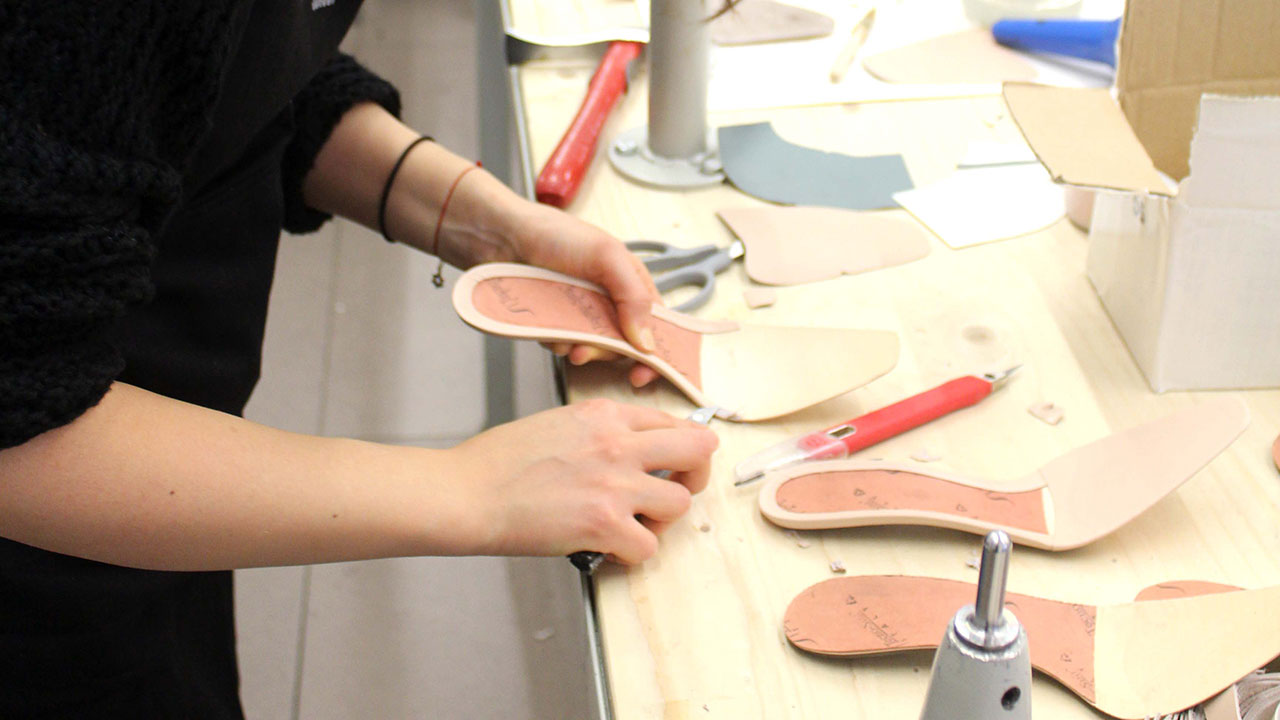
The first point to highlight is that despite the mechanization that has taken place over this century and following the Industrial Revolution, shoe manufacturing still retains strongly artisanal aspects: the knowledge and manual skill of the person operating the machinery remain essential.

A shoemaking factory uses many machines to produce a single pair of shoes. Here are just a few: the skiving machine, the split-leather machine, sewing machines, the pre-lasting and lasting machines, the heel-nailing machine, and the sole-press. None of these machines can work without an operator at their side to guide and monitor them.

We can say that machines serve as an aid to the operator’s work: they help operators work faster—and thus more productively—and increase the precision and repeatability of each process. Nevertheless, the operator’s knowledge and manual skill remain fundamental.

Only a few operations—especially in the production of dress shoes, the flagship of “Made in Italy”—can be fully automated: for example, the buffing of the mounted upper’s bottom and the application of glue to both the bottom of the upper and the sole.

Some processes, such as cutting, have evolved considerably in recent years. A shoemaking plant always requires someone capable of cutting by hand, both for prototypes (for which CAD models have not yet been created) and when working with special materials (e.g., precious leathers). It is true that advances in cutting tables now allow an increasing range of materials to be cut automatically, and today you can even see factories cutting exotic skins with these machines. However, the operator’s skill is still critical—especially in high–value-added tasks such as positioning pieces on different areas of the hide. Final operations like sorting the pieces post-cutting, on the other hand, have been automated.

In a shoe factory: the technicians behind production

The figure above shows a sequence of typical technical activities carried out in a shoe factory. A few fundamental points must be clarified: first, every company is organized differently, so this diagram does not precisely represent the structure of all shoemaking plants.

In the diagram we chose to name activities rather than roles, because the same person may perform multiple activities (for example, a single pattern‐maker might handle both prototype/sample development and industrialization).

The diagram also does not specify which activities are performed in-house and which are outsourced. For instance, it is common for prototype edge-binding to be done internally, while production edge-binding is subcontracted to a jointing workshop.

Footwear lifecycle

1. Prototyping: the first attempt to translate a style concept into a shoe. The result is a shoe that will be evaluated internally and likely modified before being launched on the market.

2. Sample production: shoes made available to the sales force to show to customers and collect orders.

3. Production: once orders are gathered, manufacturing begins. Not all samples will be produced (typically only those that reach a company-specific minimum order quantity), and customers may still request variations on the displayed samples.

In larger companies, the people who create prototypes and samples are often not the same as those who handle production. In many firms, production is even partially or entirely outsourced.

The different technical roles in a shoe factory:

  • Some of these are dedicated to technical design—for example, pattern makers and technicians responsible for developing and industrializing the shoe structures. Specific courses exist to train these professional figures.
  • Other roles are dedicated to planning, organizational coordination, internal and external logistics of materials and semi-finished products, production supervision, and product and process quality control. For these positions, it is harder to identify specific training courses that develop these exact skills. In our view, within the Italian education system these professionals should be trained through post-secondary paths such as IFTS and ITS programs.
  • Finally, there are the roles more directly involved in production (cutting, skiving and jointing, lasting and finishing). In the Italian education system, these professionals should come from vocational institutes or IeFP (Education and Training) pathways. However, except for a few cases, it is difficult in Italy to find Vocational Schools or Professional Training Centres (CFP) capable of organising training programmes that meet the needs of industry.

The result is that these roles are often still trained internally within companies, by working alongside experienced staff through apprenticeship schemes or using resources from inter-professional funds (e.g. Fondimpresa). In some Regions there are short courses financed by ESF (European Social Fund) resources or through Employment Agency funds (Formatemp).

Over to the National Association of Footwear Manufacturers (Assocalzaturifici):

We asked Assocalzaturifici to help us map out the courses available throughout Italy for training the various technical figures employed in shoe factories. The following contribution was jointly prepared by Tommaso Cancellara, Director of the National Association.

On the Assocalzaturifici website, you will find a list of schools offering footwear-related training, organised by educational level.

Secondary training

This refers to the specialised three-year programmes in upper secondary schools (especially technical institutes). In the seven regions that host Italy’s footwear districts, schools have introduced “Fashion” tracks that include modules specifically focused on shoemaking.

The problem is that, because these are dedicated teaching positions, school principals may hire sector experts only if no qualified teachers are available on the official roster. This is unfortunate, as students often lack the proper tools and insights to really understand the industry.

To address this, Assocalzaturifici has signed a memorandum of understanding with ANPAL to improve the quality of school-to-work internship projects, ensuring mutually beneficial collaboration between companies and schools.

Post-graduate training

For Graduates, the Footwear Sector Offers Several Opportunities:

1. IFTS Courses (Higher Technical Education and Training)

▪ Funded by the Regions and completely free for students.

▪ Activated each year based on the training needs of companies in the sector.

▪ Recently concluded IFTS courses for “Footwear Technician” in Lombardy, Marche, Emilia-Romagna, and Veneto, which will be re-funded and restart in October.

▪ Duration: one year (approximately October to July).

2. ITS Courses (Higher Technical Education)

▪ Delivered by Foundations comprising companies, universities, and upper secondary schools.

▪ Offer training in various footwear and fashion roles, such as:

◦ Process and product technician

◦ Collection coordinator

◦ Marketing and internationalization technician

For Graduates, the Footwear Sector Offers Several Opportunities:

IFTS Courses (Higher Technical Education and Training)

  • Funded by the Regions and completely free for students.
  • Activated each year based on the training needs of companies in the sector.
  • Recently concluded IFTS courses for “Footwear Technician” in Lombardy, Marche, Emilia-Romagna, and Veneto, which will be re-funded and restart in October.
  • Duration: one year (approximately October to July).

ITS Courses (Higher Technical Education)

  • Delivered by Foundations comprising companies, universities, and upper secondary schools.
  • Offer training in various footwear and fashion roles, such as:
    • Process and product technician
    • Collection coordinator
    • Marketing and internationalization technician

Assocalzaturifici collaborates with and promotes the following ITS programmes:

  • ITS “Moda Calzature” in Marche
  • ITS Cosmo in Veneto and Lombardy
  • ITS Moda in Campania
  • ITS MITA in Tuscany

and provides, upon request, its expertise and teaching staff.

The courses last two years and award credits that can be used for university admission. The employability rate of students attending these programmes is around 85 %.

Admission to IFTS and ITS courses requires a selection process with minimum prerequisites (a vocational diploma and English proficiency).

There are also private courses—especially for pattern makers. Schools such as Arsutoria, Cercal, and Politecnico Calzaturiero, all part of Assocalzaturifici’s training network, offer private programmes for this highly sought-after role in the footwear industry. Saturday-morning classes are particularly popular, as they cater to professionals already employed who wish to advance their careers.